
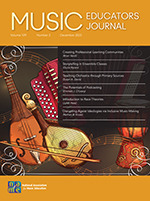
Music Educators Journal
Music Educators Journal (MEJ) offers peer-reviewed scholarly and practical articles on music teaching approaches and philosophies, instructional techniques, current trends and issues in music education in schools and communities and the latest in products and services.
Most issues include Readers Comment (letters from readers); NAfME Today (news for music educators); Samplings (summaries of recently published articles from other NAfME journals, including Journal of Research in Music Education, Journal of Music Teacher Education, General Music Today, and Update: Applications of Research in Music Education); and video and technology reviews. Occasional Idea Bank columns present tips from practitioners at all levels
Other NAfME journals can be found at
Journal of General Music Education (http://gmt.sagepub.com)
Journal of Music Teacher Education (http://jmte.sagepub.com)
Journal of Research in Music Education (http://jrme.sagepub.com)
Update: Applications of Research in Music Education (http://upd.sagepub.com)
Submit your manuscript today at https://mc.manuscriptcentral.com/mej.
Music Educators Journal offers peer-reviewed scholarly and practical articles on music teaching approaches and philosophies, instructional techniques, current trends and issues in music education in schools and communities and the latest in products and services.
| Lisa Martin | Ohio University, USA |
| Doug Orzolek | University of St. Thomas, Saint Paul, MN, USA |
| Ryan Shaw | Michigan State University, USA |
| Christopher Woodside | Executive Director, National Association for Music Education, USA |
| John Donaldson | Assistant Executive Director for Professional Development and Publications, National Association for Music Education, USA |
| Amy Bradley | National Association for Music Education, USA |
| Catherina Hurlburt | National Association for Music Education, USA |
| Abigail Gyamfi | National Association for Music Education, USA |
| Amy Bradley | National Association for Music Education, USA |
| Daniel J. Albert | University of Massachusetts Amherst, MA, USA |
| Julie Bannerman | University of Alabama, Tuscaloosa, AL, USA |
| Jacob Berglin | Western Michigan University, USA |
| Cara Bernard | University of Connecticut, USA |
| Chris Bulgren | Georgia Southern University, GA, USA |
| Kelly Bylica | Boston University, Boston, MA, USA |
| Matthew S. Clauhs | Ithaca College, NY, USA |
| Kimberly Councill | University of Utah, UT, USA |
| Mara Culp | University of Rochester-Eastman School of Music, Rochester, NY, USA |
| Donna Gallo | University of Illinois at Urbana-Champaign, IL, USA |
| Alyssa Grey | Berry College, USA |
| Erik Johnson | Colorado State University, USA |
| Edward R. McClellan | Loyola University New Orleans, LA, USA |
| Kelly A. Parkes | Columbia University, United States of America |
| Phillip Payne | Kansas State University, USA |
| Seth Taft | Independent Researcher, USA |
| Jui-Ching Wang | Northern Illinois University, DeKalb, IL, USA |
| Brian Weidner | Butler University, USA |
| Kristina Weimer | University of Northern Colorado, USA |
| Hyesoo Yoo | Virginia Polytechnic Institute and State University School of Performing Arts, USA |
| Amelia Armstrong | Plattesville High School, Wisconsin, USA |
| Christopher Brandt | Graceland University, IA, USA |
| Kelly Bylica | Boston University, Boston, MA, USA |
| Drew Coles | Teachers College, Columbia University, USA |
| Jose Diaz | Hunter College, CUNY, USA |
| Crystal Gerrard-Ramirez | University of North Texas, USA |
| Lori Gray | Boise State University, USA |
| John Hart | Keene State College, NH, USA |
| Diana Hawley | Iowa City Community School District, Iowa, USA |
| David M. Hedgecoth | Ohio State University, Columbus, OH, USA |
| Sara Jones | DePaul University, USA |
| Benjamin Kambs | Oklahoma State University, USA |
| Becky Marsh | Butler University, USA |
| Paul Mayhew | University of Central Arkansas, USA |
| Emmett O’Leary | Virginia Polytechnic Institute and State University, USA |
| Michelle Paise | Morehead State University, USA |
| Ryan Scherber | Case Western Reserve University, USA |
| Alvin Simpson | West Liberty University, USA |
| Julie Song | University of North Florida, USA |
| Rachel Sorenson | Kennesaw State University, USA |
| Emery Warnock | Piedmont University, GA, USA |
| Renee Wilson | Mississippi College, USA |
Music Educators Journal Guidelines for Contributors
Music Educators Journal (MEJ) is a peer-reviewed journal that encourages music education professionals to submit manuscripts about all phases of music education in schools and communities, practical instructional techniques, teaching philosophy, and current issues in music teaching and learning. The main goal of MEJ, like that of NAfME, is to advance music education.
Unless specifically noted, articles in MEJ do not necessarily represent the official policy of the National Association for Music Education.
MEJ articles are refereed by practicing professionals who judge manuscripts on their importance, originality, timeliness, scope, accuracy, and style. Approximately six manuscripts are accepted as articles for publication in each issue. These guidelines pertain to those manuscripts. Manuscripts submitted for consideration as full-length articles should be characterized by the following:
Clarity. Articles should be written in a straightforward, conversational style that avoids unnecessary jargon, technical language, and excessive reliance on long quotations from other sources.
Grounding. While MEJ is not a research journal, submissions should be grounded in the professional literature. Articles with no citations or reference to previous work in the area will not be considered for publication.
Brevity. The main text of manuscripts should be no more than 12 pages in length, excluding the abstract and references. Text should be presented in 12-point font with double-spacing throughout. End notes (beyond references) should be kept to a minimum and may be edited for brevity prior to publication.
Usefulness. Articles should address the needs of the many music educators who read the journal and should not have been previously published elsewhere. Authors should avoid personal asides that are not relevant to the primary topic, as well as content that promotes a person, performing group, institution, or product.
Strategic Plan. Authors should briefly review the NAfME Strategic Plan at http://www.nafme.org/about/mission-and-goals/ to include information in their submissions on one or more of the following topics: Advocacy, Serving the Profession and the Music Educator, Research, and NAfME Organizational Vitality.
Manuscript Submissions
Manuscripts should be submitted electronically to http://mc.manuscriptcentral.com/mej. Authors will be required to set up an online account on the SAGE Track system powered by ScholarOne. From their account, a new submission can be initiated.
Authors will be asked to provide the required information (author names and contact information, abstract, keywords, etc.) and to upload the “title page” and “main document” separately to ensure that the manuscript is ready for a blind review. The site contains links to an online user’s guide (Get Help Now) for help navigating the site. Submit a manuscript file, plus a separate page with the title, authors’ names and affiliations, keywords, and complete contact information for the corresponding author (mail and e-mail addresses as well as telephone and fax numbers).
Manuscripts should follow the Chicago Manual of Style (16th ed.). The main text of manuscripts should be approximately 3,500 words (12 double-spaced typed pages). See “MEJ Departments” for manuscripts that are significantly shorter than 3,500 words. Authors of manuscripts with main texts exceeding 12 double-spaced typed pages may be asked to shorten their manuscripts prior to review. Especially welcome are topics of value, assistance, or inspiration to practicing music teachers.
Digital/media content associated with a scholarly (featured) Music Educators Journal manuscript is considered manuscript content. All such content will be evaluated by members of the MEJ Editorial Committee as part of the manuscript review process.
Submission of a manuscript implies commitment to publish in the journal. Please state in your cover letter that the material has not been published elsewhere in substantially similar form or with similar content.
Format of Submissions
A cover letter includes the author’s name, address, daytime phone number, e-mail address, mailing address, and title or position.
You will be asked to include an abstract with your submission. Your abstract is a way to inform readers of the contents of your article and entice the reader to continue investigating your work. Another way to think about an abstract is that it should explain or summarize what your first paragraph cannot explain. For our purposes, please submit an abstract that contains four sentences:
- Sentence 1: Your abstract should begin with a statement or query that will draw the reader to your text. The first sentence may express the purpose for conducting a study, describe the problem/challenge that you will address in the text, or provide an overview of your primary thesis.
- Sentences 2 and 3: A second and third sentence should summarize the “heart” of the article; the main thesis or primary ideas represented within. If your article is a report of research, summarize the research method, context, participants, and how you collected and analyzed data. This can be the end of a first paragraph and, for articles written as essays or innovative/best practices, this will be enough. For a report of research, you can use a second paragraph to summarize findings in a few sentences.
- Sentence 4: A final sentence can invite the readers to consider the implications for teaching practice.
Note: the abstract submitted here is intended for reviewers; it will serve as the basis for the published abstract written in collaboration with the NAfME editorial staff.
The article should be double-spaced with pages numbered. The author’s name and current institution should not appear anywhere in the manuscript itself but should be included in the accompanying cover letter. Manuscripts may be written using a first-person point of view. However, when referencing their own work, authors should either write in the third-person (allowing for complete references) or create placeholders for corresponding references listing only “Author’s Work” and nothing further. The inclusion of title and journal information allows for an author’s identity to be readily established. Once the manuscript reaches the final stage of review, complete reference information may be requested so that the submission can be fully assessed.
Music examples, figures, photographs, and other illustrations must be checked for accuracy before submission.If any copyrighted materials are used, documentation verifying that the author has permission to use the material must be included. You will be asked to complete a Request for Permission to Reprint Material form.
Authors are responsible for obtaining permission to publish any author-submitted photographs or illustrations, and written permission to SAGE of a parent or guardian of any minor pictured is needed before such images are published. You will be asked to complete anAudio/Visual Likeness Release form.
Tables and figures should be kept to a minimum, be self-explanatory, and supplement (not duplicate) the text. Tables should be placed at the end of the file, following text and references, with callouts for each in the text. Elements in tables should be separated by tabs, not cells or lines. High-resolution figures should be uploaded as separate electronic files, with callouts for each in the text. Acceptable file formats for figures include TIFF, EPS, and JPEG, and PDF Microsoft Application Files are acceptable for vector art (line art). (Please do not send glossies.)
Up to three photographs are a welcome part of accepted articles. Each photograph must be accompanied by a short caption and photo credit information. Please contact Ella Wilcox at EllaW@nafme.org if you feel it is necessary to have more than three photographs included with your article. Acceptable file formats for photographs include TIFF, EPS, and JPEG, and PDF Microsoft Application Files are acceptable for vector art (line art).
Editorial Policy. All manuscripts accepted for publication are edited to conform with MEJ style policies, which are based on The Chicago Manual of Style (16th ed.). We use endnotes, not the author-date system. Manuscripts may also be edited to meet the requests of the Editorial Committee or to fit available space. Edited copy is sent electronically to the author for approval before publication. Final decisions about scheduling of publication, style, title, presentation, grammar, artwork, and deleted passages remain with the editor.
Audio-Video Policy. Because Music Educators Journal (MEJ) primarily reaches members of the National Association for Music Education in digital form, authors are welcome to supplement their articles with high-quality sound and visual elements that enhance the presentation of their ideas.
· Digital/media content associated with a scholarly (featured) Music Educators Journal manuscript is considered manuscript content. All such content will be evaluated by members of the MEJ Editorial Committee as part of the manuscript review process.
· Each MEJ article can have a maximum of 25 gigabytes (GB) of storage.
-Audio files should be limited to 10 megabytes (MB) because the user download experience can be cumbersome if the files are too large. MP3 files are required.
-Videos can be larger files, up to 75 GB. Required formats are AVI and MP4, both of which are recognized by PC and Mac systems.
· SAGE Publications, which archives MEJ data, does not modify the files in any way, so to make sure readers have quick access, authors are advised to provide optimized file types and compression. Authors are reminded that most MEJ data is accessed through phone and tablet devices, and audio-video files must play smoothly on these devices.
A SAGE Audio-Visual Likeness Release form needs to be signed for any audio-video footage and/or recordings.
Publication Policy. MEJ is copyrighted as an entity, so authors must transfer copyright to NAfME.
Payment is not possible for contributions to the magazine. Each author receives two copies of the issue in which his or her article appears; authors may also order additional copies at cost.
MEJ Departments. Short, practical articles (500–1,000 words) containing ideas music educators can use in the classroom are always welcome for submission to Idea Bank (contact Ella Wilcox at EllaW@nafme.org for details). NAfME members are also invited to review books, technology, and videos; see the guidelines for writing reviews at http://musiced.nafme.org/resources/periodicals/.
For more information, please refer to the SAGE Manuscript Submission Guidelines.